Some days, everything works. The API responds perfectly, the AI gives exactly the right answer, and the system holds up under pressure. Other days, a single bug brings everything down, and you spend hours staring at logs, trying to figure out what went wrong. On those hard days, my colleagues at Cellogen remind me why we are doing what we do — that on the other side of this code is a patient waiting for a cancer treatment that has not been developed yet.
From Servers to Something Bigger
I started my career as a backend developer. My world was APIs, databases, and servers. I was good at it, but over time, I started to feel like something was missing. The systems I built worked perfectly, yet they were not doing anything that felt truly meaningful.
So, when the opportunity came to move into AI engineering at Cellogen Therapeutics, I took it without hesitation.
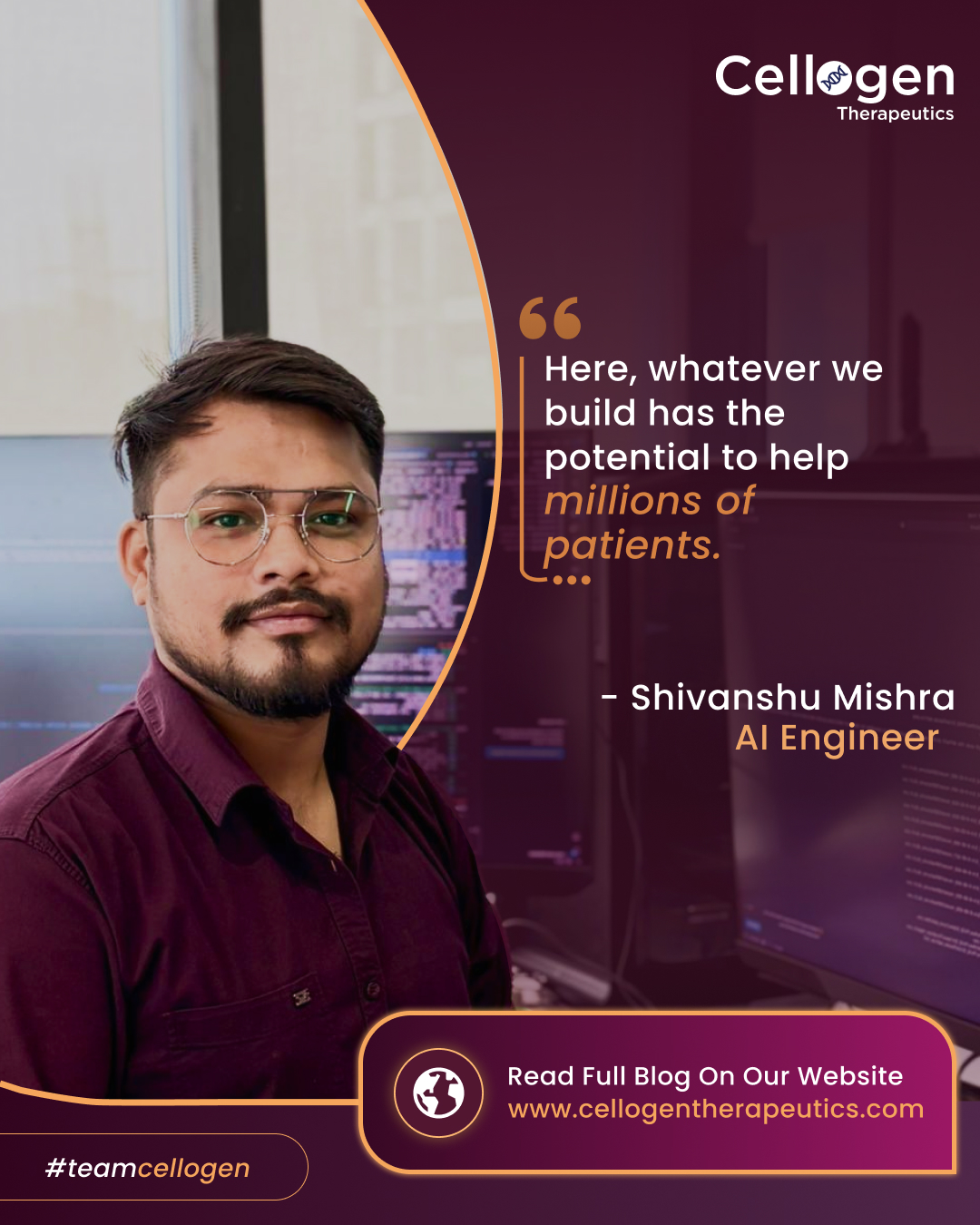
"Here, whatever I build has the potential to help millions of patients."
CAR-T therapy is one of the most advanced cancer treatments in the world. It takes a patient’s own immune cells, engineers them in a lab, and infuses them back into the body to fight cancer. The science behind it is remarkable, but for most people, it is almost impossible to understand. And yet, understanding it matters, because patients need to make decisions, and families need to prepare.
Most platforms treat everyone the same. A patient and a specialist get the same wall of text. That is where things break down, and that is exactly the gap we set out to close.

Building the CAR-T AI Agent
We are currently building the CAR-T AI Agent — a conversational AI system that makes CAR-T therapy genuinely understandable for anyone who needs it.
Right now, the system is live for patients. Someone who is confused can log in, ask anything in layman’s language, and gain clarity. They do not need to understand the science. They do not need to read research papers. They simply ask their questions, and the system answers in a way that actually makes sense to general users.
Developing this system was not easy. In the early stages, responses were either too complex for general users or too shallow to be useful. Getting the system to understand not just the question, but what the person actually needed, took weeks of fine-tuning and rebuilding. But watching it finally work — watching it give a real, helpful answer to someone who had no idea where else to turn — made every frustrating hour worth it.
The vision goes further. We are building towards a system that serves people across the entire spectrum of this field — from those who need simple answers, to those who need deep scientific detail, to those making critical medical decisions. That work is ongoing, and the foundation is being laid carefully, because everyone who will eventually use it deserves something that truly works.
A QR Code That Replaces a Manual
Cellogen Therapeutics produces lab kits used in scientific workflows. These kits used to come with printed manuals — long, static, and almost never helpful in the moment you actually needed them. Researchers would get stuck, flip through pages, and either figure it out slowly or wait for support.
We put a QR code on the kit. Scan it, and you get a chatbot that knows exactly which product you are holding. Ask it anything — how to run the test, what a result means, what to do when something goes wrong — and it answers instantly in plain language. No setup, no searching, no waiting.
I built the backend system that links each QR code to the right product data and AI context. The first time I watched someone scan it and immediately get the answer they needed, I felt a deep sense of satisfaction.
The deeper I go into this work, the more I believe that AI alone is never the answer. Around the model, you need reliable APIs, secure authentication, and infrastructure that does not break when ten users become a thousand. All of it has to work together, invisibly, so that the person on the other end simply gets their answer.
In healthcare, this is not just a technical requirement — it is a responsibility. The information has to be accurate, the system has to be trustworthy, and the experience has to be simple enough for anyone to use.
Now, I feel like I have found exactly the right place — building systems that do not just work, but actually help people when they need it the most. And that, for me, is everything.
- CAR-T therapy